Category: Vancouver YVR

  • Air Canada Readies for Summer 2023 in Canada with New and Restored Services, and Increased Frequencies

    • New, non-stop service between Montreal and Fort McMurray
    • Increased frequencies on Toronto-Kelowna, Winnipeg-Toronto, Montreal-
      Vancouver
    • Air Canada will offer over 600 daily flights on 97 routes to 51 destinations
      in Canada this summer, the most of any carrier

    MONTREAL, Dec. 6, 2022 /CNW Telbec/ – Air Canada today announced a new service between Montreal and Fort McMurray that will launch next June as part of the carrier’s Canadian summer schedule. For summer 2023, Air Canada is also restoring suspended services and increasing frequencies on popular routes across Canada, as the company augments its Canadian network following the pandemic.
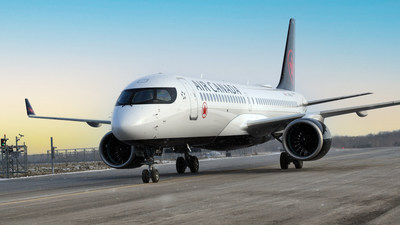
    Air Canada will offer over 600 daily flights on 97 routes to 51 destinations in Canada this summer, the most of any carrier. (CNW Group/Air Canada)

    “As the country’s flag carrier, Air Canada’s increased Canadian summer schedule further reinforces our role in providing critical connectivity to Canadians coast-to-coast. Our new Montreal-Fort McMurray service brings easier access from eastern Canada to one of the critical economic hubs of Alberta. And with the prudent restoration of suspended routes and increased frequencies on others, we are improving our customers’ options for domestic travel. We are looking forward to an exceptional summer, with service on 97 domestic routes to 51 Canadian airports, making us the largest Canadian carrier, with the most seats and capacity available for travellers,” said Mark Galardo, Senior Vice President of Network Planning and Revenue Management at Air Canada.

    “Furthermore, we’ve built our Canadian summer schedule to synchronize with our recently announced summer international schedule, facilitating connectivity through our hubs for our customers, whether they’re traveling within Canada, across the border to the US, or to our many destinations worldwide. “

    New service between Montreal and Fort McMurray will begin June 20, 2023. Flights will be operated year-round, three days a week, by Air Canada Rouge using an Airbus A319 aircraft with 136 seats in a Premium Rouge and Economy Class configuration. With its new Montreal and existing Toronto service, Air Canada will be the only carrier connecting Fort McMurray non-stop to Quebec and Ontario.

    FlightDepartsArrivesDays of Week
    AC1943Montreal 08:15Fort McMurray 10:38Tuesday, Wednesday, Thursday
    AC1942Fort McMurray 12:05Montreal 17:52Tuesday, Wednesday, Thursday

    Air Canada also announced today the resumption of several seasonal routes and one previously suspended route. This includes daily Gander-Toronto flights beginning June 1, London, Ontario-Montreal flights beginning June 17, four-times weekly Fort McMurray-Toronto flights resuming May 1, and three-times weekly Calgary-Quebec City flights starting June 19. In addition, Air Canada is planning daily widebody service on its Ottawa-Vancouver route while also offering multiple options to popular leisure destinations, such as Kelowna and Victoria through its three main hubs.

    Frequency Increases

    RouteFrequency (Summer 2023 versus Summer 2022)
    Edmonton-MontrealIncreases to four times daily from twice daily
    Vancouver-MontrealIncreases to six times daily from five daily
    Calgary-TorontoIncreases to 13 times daily from 11 daily
    Kelowna-VancouverIncreases to eight times daily from seven daily
    Winnipeg-TorontoIncreases to seven times daily from five daily
    Saint John-TorontoIncreases to three times daily from once daily
    Kelowna-TorontoIncreases to two times daily from once daily
    Quebec City-VancouverIncreases to five times from three times weekly

    Aeroplan members can earn and redeem points on all Air Canada flights; and, where available, for eligible customers and Aeroplan members, priority check-in, Maple Leaf Lounge access, priority boarding and other benefits.

    On October 13, 2022, Air Canada released its international summer schedule, including new European services.

    About Air Canada

    Air Canada is Canada’s largest airline, the country’s flag carrier and a founding member of Star Alliance, the world’s most comprehensive air transportation network. Air Canada provides scheduled passenger service directly to 51 airports in Canada, 51 in the United States and 88 internationally. It holds a Four-Star ranking from Skytrax. Air Canada’s Aeroplan program is Canada’s premier travel loyalty program, where members can earn or redeem points on the world’s largest airline partner network of 45 airlines, plus through an extensive range of merchandise, hotel and car rental rewards. Its freight division, Air Canada Cargo, provides air freight lift and connectivity to hundreds of destinations across six continents using Air Canada’s passenger flights and cargo-only flights with its fleet of Boeing 767-300 freighters. Air Canada has committed to a net zero emissions goal from all global operations by 2050.
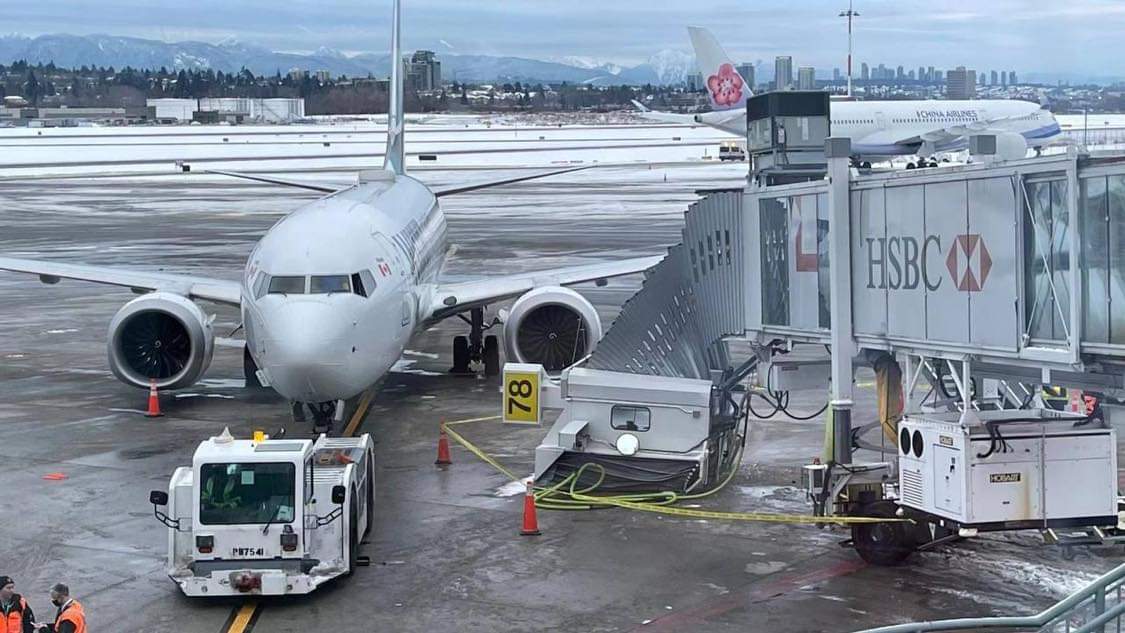
  • Aircraft loading bridge collapses at YVR, no injuries

    From City News Vancouver – link to source story

    A collapsed aircraft loading bridge at Vancouver International Airport on Jan. 1, 2022.
    A collapsed aircraft loading bridge at Vancouver International Airport on Jan. 1, 2022. (Submitted)

    By Paul James and Aly Laube | January 1, 2022

    A flight leaving Vancouver International Airport had to change gates Saturday after an aircraft loading bridge from the terminal to the parked jet collapsed.

    Fortunately, no one was hurt. The bridge was empty when it caved in and crumpled close to where it connected to the unloaded plane.

    No injuries following a scary incident @yvrairport late this afternoon. Airport walkway collapsed at one of the terminals. The passengers hadn’t started boarding their flight. YVR says it’s inspected all of its walkways, and says they’re safe. @CityNewsVAN pic.twitter.com/BYIqp6ECfU

    Although those hoping to catch the flight had to move to another departure gate, airport operations weren’t impacted in any major way.

    YVR is still responsible for the maintenance, and says it has since inspected all of its bridge equipment.

    “We have a team that is actively investigating the exact cause of the failure and we don’t yet have a clear cost of the damage or duration that the bridge will be out of service,” a statement from the airport said.

    “We are confident this was an isolated incident on one of the bridge components and all equipment at YVR is safe.”

    The collapsed bridge will be out of service until further notice.

  • Passenger Arrested for Refusing to Wear Face Mask, Lights Cigarette Instead

    From CTV News

    Guest smoking, not wearing mask, forces WestJet flight to land in Winnipeg on weekend

    News from CTV News – link to story and video

    Josh Crabb Reporter/ Video journalist | Thursday, June 18, 2020

    https://www.ctvnews.ca/polopoly_fs/1.4555116.1566178137!/httpImage/image.jpg_gen/derivatives/landscape_960/image.jpg

    WINNIPEG — The James Richardson International Airport welcomed an unexpected flight this past weekend.

    The RCMP said officers were called Sunday afternoon around 2:30 when a WestJet flight travelling from Vancouver to Toronto was forced to land in Winnipeg due to an “unruly” passenger.

    “They were advised this male had lit up a cigarette on board and was also not listening to any of the directions from the flight crew which included to don his personal safety mask as well,” said Cpl. Julie Courchaine of the Manitoba RCMP.

    Police say a 60-year-old man from Surrey B.C., Balvir Singh, was arrested and taken into custody. He’s been charged with several offences — including failing to comply with the flight crew’s instructions to wear a face mask.

    According to Transport Canada, it’s the first time someone has been charged with that offence which carries a maximum fine of $5,000.

    The rule falls under an interim order put in place by Transport Canada because of COVID-19.

    A directive issued April 20 by Transport Canada requires all passengers to wear a non-medical face mask or covering during a flight.

    “In support of the directive, it is mandatory for guests to wear protective face coverings throughout their travel journey, including at the airport and while in flight,” reads a portion of the WestJet statement. “In addition and per the directive, travellers are required to show that they have a suitable face-covering prior to boarding a WestJet flight.”

    Inside the airport, signs at security checkpoints highlight the face mask rules. Traveller Waffa Assaf came prepared with masks for her flight and has no problem with wearing one.

    “It’s good to wear it and prevent yourself and others from getting sick,” she said.

    The man in the WestJet incident has also been charged with public mischief over $5,000 and two charges under Canadian Aviation Security regulations for smoking on board and failing to comply with the flight crew’s instructions.

    None of the charges have been tested in court.

    His lawyer Matt Gould says there was a language barrier.

    “In terms of what an individual was told or how that was interpreted and what was made from that, it’s difficult to come to any useful conclusion at this time,” he said. “Certainly everyone’s innocent until proven guilty.”

    While the allegations also involve smoking on a plane, Gould says the incident highlights how serious the consequences can be if someone refuses to wear a mask – starting with steep fines and harsher penalties if a plane is forced to make an unplanned stop.

    “If the issue with respect to wearing a face mask exacerbates the situation or grows into something that causes a real problem on a flight, that can result in criminal charges,” he said.

    WestJet says it apologized to other passengers for the delay before refueling and departing for Toronto. 

  • Support to Canada’s Air Transportation Sector

    From: Department of Finance Canada ~ 30 March 2020

    Backgrounder

    The Government of Canada recognizes the unprecedented disruption to the air transportation sector resulting from the COVID-19 pandemic. Since the beginning of the pandemic, air passenger traffic has declined significantly as governments around the world impose border restrictions and advise their citizens to avoid unnecessary travel as a measure to slow the progression of the disease.

    Support to Airports

    Airports rely on fees paid by airlines and passengers to sustain their operations. As passenger traffic declines, airports are seeing their revenues fall, while at the same time they need to ensure safe operations.

    To help airports reduce cost pressures and preserve cash flow as they deal with the effects of COVID-19 on their revenue, the government is waiving rents paid on ground leases for the 21 airport authorities that form part of the National Airport System and that pay rent to the government. The government will waive rent payments for March 2020 through December 2020.  The government is also providing comparable treatment for PortsToronto, which operates Billy Bishop Toronto City Airport, by waiving payments made to the federal government on revenues generated by the airport. This will provide relief up to $331.4 million, reflecting payments in the same period of 2018.

    By waiving ground lease payments, the government is helping these airport authorities to preserve cash flow during the disruption. This will allow them to redeploy cash to help maintain their operations and to support recovery strategies. This approach is consistent with actions taken to support the sector during previous major disruptions, such as the SARS outbreak in 2003.

    The 21 National Airport System airport authorities covered by this measure are not-for-profit, non-share capital corporations that pay rents to operate airports in Canada under long-term leases with Transport Canada. Rents are based on revenues earned from operating the airports and related lands, which are owned by the government.

    The 21 airport authorities that will receive relief are:

    • St. John’s International Airport Authority
    • Gander International Airport Authority Inc.
    • Halifax International Airport Authority
    • Charlottetown Airport Authority Inc.
    • Saint John Airport Inc.
    • Greater Moncton International Airport Authority Inc.
    • Fredericton International Airport Authority
    • Aéroport de Québec Inc.
    • Aéroports de Montréal
    • Ottawa Macdonald-Cartier International Airport Authority
    • Greater Toronto Airports Authority
    • Greater London International Airports Authority
    • Thunder Bay International Airports Inc.
    • Winnipeg Airports Authority Inc.
    • Regina Airport Authority
    • Saskatoon Airport Authority
    • Edmonton Regional Airports Authority
    • Calgary Airport Authority
    • Prince George Airport Authority Inc.
    • Vancouver International Airport Authority
    • Victoria Airport Authority.

    PortsToronto operates the Billy Bishop Toronto City Airport and pays an annual charge to Transport Canada based on the revenues it earns under the terms of its letters patent.  PortsToronto revenues include those generated from operating Billy Bishop Toronto City Airport.

  • Canada’s Airlines, Airports Among World’s Worst For Delays, And It Could Soon Get Worse

    News provided HuffingtonPost.ca – link to full article – with a hint from P.N.

    By Daniel Tencer 4 July 2019

    Under a new “passenger bill of rights,” airlines will be able to leave passengers stuck on the tarmac for longer than the current standard.
    An airplane taking off at Toronto's Lester B. Pearson International
    An airplane taking off at Toronto’s Lester B. Pearson International Airport.

    MONTREAL ― Canadian airports and airlines are some of the worst performers worldwide when it comes to flight delays, and new federal rules that allow passengers to be stuck on the tarmac for longer could make things worse.

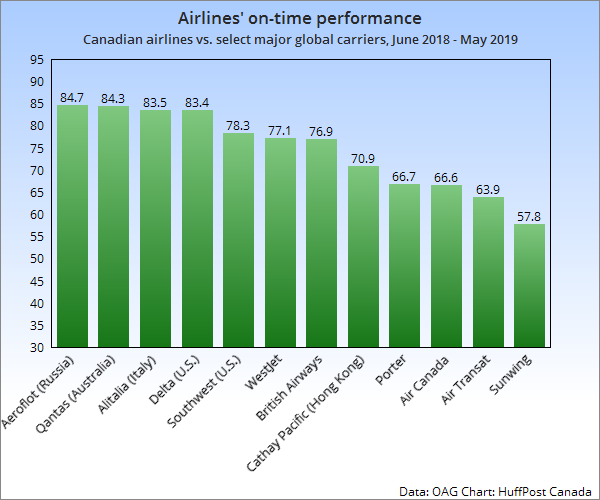
    All but one of Canada’s major airlines rank in the bottom half for on-time performance in a new survey from travel data provider OAG. 

    Canada’s best performer, WestJet, ranks 57th out of 125 airlines surveyed, with 77.1 per cent of all flights arriving on time. The country’s worst performer, Sunwing, ranks as the second-worst airline in the world, 124th out of 125, with only 57.8 per cent of flights on time.

    Sunwing experienced numerous flight glitches in recent years, including major delays in Toronto and Montreal in April, 2018, that led to a fine from the Canadian Transportation Agency.

    Canada's Airlines, Airports Among World's Worst For Delays, And It Could Soon Get

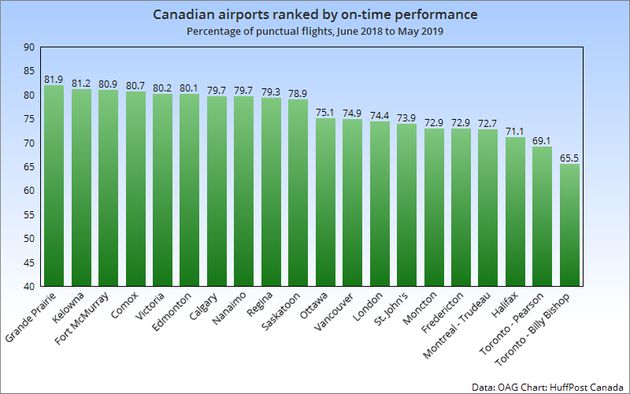
    Looking at airports, Canada doesn’t fare much better. Our best airport, in Grande Prairie, Alta., ranks 108th out of 505 airports surveyed.

    Toronto’s two commercial passenger airports, Pearson and Billy Bishop, rank as the two worst airports in Canada and among the worst in the world ― 475th and 489th, respectively.

    Interestingly, there is a yawning east-west divide, with western Canadian airports performing better than others.

    Canada's Airlines, Airports Among World's Worst For Delays, And It Could Soon Get

    The survey comes as Canada is about to launch a new “passengers’ bill of rights” that some critics say will make it easier for airlines to delay flights.

    Under the new regulations, airlines will be able to keep passengers stuck on the tarmac for up to three hours, plus an additional 45 minutes if the airline believes takeoff is imminent.

    Currently, Canada has no government-enforced limits on tarmac delays, but airlines themselves had standards built into their tariffs. The industry standard was 90 minutes, which is also what a Senate committee recommended be the rule in the new passenger bill of rights. The government rejected that recommendation.

    Airlines themselves have been pushing for longer tarmac delays. Air Canada extended its maximum tarmac time to four hours in 2018.

    Additionally, it will be very difficult to get compensation from airlines in most cases where flights are delayed or passengers are denied boarding, said Gabor Lukacs, a prominent consumer advocate who has challenged airline practices in courts.

    Watch: Here are the budget airlines in Canada. Story continues below.

    Lukacs said he worries about the possibility of longer delays under the new rules because “when something becomes legal, they will do it. On the other hand, the counterargument is it’s in the airline’s best interest to get passengers to their destination as quickly as possible.”

    Lukacs’ advocacy group, Air Passenger Rights, has accused the government of letting the airline industry dictate the new passengers’ bill of rights.

    A spokesperson for Transport Minister Marc Garneau said the tarmac delay rule was decided “based on operational realities and international best practices. For example, in the United States, air carriers are required to offer the option to disembark after a three hour delay on domestic flights, and a four hour delay on international flights.”

    While airlines frequently blame weather for flight delays, data from the U.S. federal government shows that extreme weather events are responsible for fewer than 5 per cent of flight delays in the U.S. The most common reason for delays was late-arriving aircraft, meaning flights delayed because earlier flights were delayed. This accounted for nearly 42 per cent of U.S. delays. Canada does not currently keep track of this type of data.

    But Lukacs points out that Canada has much harsher weather than most of the U.S., so it may not be a fair comparison. And Toronto’s worst-in-the-country Billy Bishop Airport has unique issues to deal with because it’s on an island.

    “This may be an apples to oranges comparison,” he told HuffPost Canada by phone.

    Nonetheless, Canada’s poor weather doesn’t explain why Alaska Airlines has a higher on-time percentage than any Canadian airline (80.7 per cent) and is the third best among U.S. airlines.

    Lukacs argues these on-time rankings are incomplete: There isn’t enough data to determine, for instance, whether it’s a particular airport or a particular airline that’s behind delays in a given place.

    Either way, airlines should be taking bad weather into account when planning their schedules, Lukacs said.

    “If airlines and airports ignore the weather realities, then you have guaranteed, built-in failure,” he said.

  • Air Canada prepares rouge subsidiary for ULCC competition

    From Air Transport World – 9 August 2018 – 

    Rouge-Boeing-767-300-Coastal-5As the Canadian ULCC market heats up, Air Canada said it is prepared to leverage the significant flexibility of its rouge subsidiary to ward off competition, from adding flights in major domestic markets to re-configuring aircraft to match rivals’ all-economy offerings.

    “We have been preparing to ensure that we have all the tools necessary to offset [low-cost competition] and ensure that we are not negatively impacted,” Air Canada passenger airlines president Ben Smith said.

    Set up five years ago as a leisure-destination operation, rouge’s network is heavily transborder and international, with only a handful of year-round and seasonal routes within Canada. None of them link any of the country’s six largest metropolitan areas—Toronto, Montreal, Vancouver, Calgary, Ottawa and Edmonton—part of the carrier’s strategy to preserve mainline margins.

    Calgary-based WestJet and its ULCC subsidiary Swoop are following a similar network strategy, but unlike rouge’s two-class aircraft, Swoop operates 189-seat all-economy Boeing 737-800s.

    Fast-growing ULCC Flair Airlines is taking the strategy a step further, operating single-class, 158-seat 737-400s on popular domestic routes such as Toronto-Calgary and Vancouver-Calgary. The Edmonton-based carrier’s recent announcement to move its Hamilton services to Toronto will make it even more prominent, and it plans to follow rouge and Swoop into transborder services.

    While Montreal-based Air Canada set up rouge as a hybrid low-cost leisure carrier, the company has flexibility to transform its subsidiary to meet market needs, thanks in part to a 2017 amendment to its pilot agreement. The deal lifted Rouge’s fleet-size cap of 50—25 widebodies and 25 narrowbodies—by permitting more narrowbodies based on Air Canada’s mainline operation and permits rouge aircraft to replace regional feeder flying.

    Air Canada is already taking advantage of the narrowbody cap’s removal. Its 53-aircraft fleet includes 22 Airbus A319s and six A321s, and it plans to add three A320s next year. It also is evaluating its rouge deployment strategy in light of shifting market dynamics.

    “We have not deployed one of our options, which is rouge on any of the major markets. We can do that,” Smith said. “We can also modify the rouge model …. We can densify the rouge aircraft to bring down the CASM. So, a lot of flexibility.”

    Usage of the A320s will be determined by the best opportunities. While the strategy could change, Smith said three options are being considered: adding domestic capacity, flying attractive “southern” routes to Florida, Mexico, and the Caribbean, or replacing regional-feeder flying.

    “We’re quite pleased with the position we’re in,” he said.

    , sean.broderick@aviationweek.com

  • Vancouver Airport YVR announces $9.1 billion expansion – Updated

    YVR investing $9.1 billion into the airport under its 20-year blueprint

    Today, Vancouver International Airport (YVR) broke ground on a number of capital construction projects to enhance the airport experience and improve YVR’s competitive position as a world-class connecting hub. The projects are part of YVR’s multi-year expansion plans that will see the airport complete 75 major projects, totaling $9.1 billion over the next 20 years.

    Vancouver Airport Authority President and CEO Craig Richmond was joined by British Columbia Premier John Horgan; Ken Hardie, Member of Parliament for Fleetwood-Port Kells; and Fiona Famulak, President of the Vancouver Regional Construction Association to celebrate the groundbreaking of YVR’s construction projects. They include building one of the largest GeoExchange systems in Canada, significant terminal expansions, new parking options and improved vehicle rental facilities.

    YVR is one of the fastest-growing airports in North America. It welcomed a record 24.2 million passengers in 2017 and is forecasting 32 million passengers by 2022. About 327,000 tonnes of cargo are expected to move through the airport by 2020. These newest construction projects will improve the speed with which people and goods move through YVR, and provide passengers with a wide range of compelling offerings and amenities.

    YVR plays a significant role in the local, provincial and national economy—creating jobs and driving business activity. The airport supports 24,000 jobs on Sea Island and more than 100,000 jobs across British Columbia. YVR’s operations—together with tourism and cargo—contribute more than $16 billion in total economic output, $8.4 billion in GDP and $1.4 billion in government revenue across British Columbia. Each new flight through YVR creates hundreds of jobs and contributes millions of dollars in economic benefit to the province.

    The expansion projects will have significant economic and employment benefits in the region. By the end of 2018, construction activities at YVR will create nearly 2,500 full-time construction jobs on Sea Island and hundreds more off-site. Much of the work will be done in the province, offering a significant number of jobs for British Columbians.

    YVR’s multi-year expansion plans are made possible by YVR’s unique, not-for-profit operating model. YVR receives no government funding and all profits generated at YVR are reinvested back into the airport for the benefit of its customers, partners and communities.

    To learn more about YVR’s key projects that will enhance the airport experience, please visit yvr.ca/construction.

    (more…)