(WINNIPEG, MB – October 18, 2023) – Five years since the museum last held their annual fundraiser, the much-anticipated event is back in a new space and with a new brand.
The Preservation Ball will raise funds for RAMWC’s award-winning STEM programming. Since launching these programs in the fall of 2022, nearly 8,500 students have participated in curriculum-based programs designed to teach the science, technology, engineering, and math principles of aviation and aerospace.
The mission of RAMWC is to preserve and promote the stories of aviation in Western and Northern Canada, and to address the needs of our community through education and inspiration. Currently, the most pressing needs are a skills shortage in the aviation and aerospace industries and access to STEM education for underserved communities. Participating in these programs is cost-prohibitive for many; to that end, RAMWC has created an Access-For-All fund.
“Our Access fund ensures that all students in Winnipeg have equal opportunity to learn about the fascinating world of aviation and aerospace through the programs we offer and the partnerships we hold,” explains RAMWC President and CEO Terry Slobodian. “The continued generosity of our community means that any student can explore and experience their potential in this sector. It truly opens the door to a world of possibilities.”
The inaugural Preservation Ball also serves to honour a long-time RAMWC supporter, Tannis Richardson. Not only was Ms. Richardson one of the founders of the museum’s annual fundraiser, originally called the Out of the Blue gala, she was integral to the search and recovery of one of the museum’s signature aircraft, the Ghost of Charron Lake.
Preservation Ball Co-Chair Blain King says, “We’re thrilled be recognizing Tannis Richardson as our Honorary Patron. She is a true visionary whose generosity and support have helped elevate our museum to a world-class facility.”
This year’s event takes place on October 21 at the Royal Aviation Museum. Tickets for the 2023 Preservation Ball are sold out, but those interested in supporting the museum’s Access-For-All fund can do so by participating in the event’s online auction or donating online: https://www.preservationball2023.com/lite-ui/?controller=lots&category=All%20Lots
About the Royal Aviation Museum of Western Canada The Royal Aviation Museum of Western Canada was established in 1974 by a small group of visionaries committed to preserving Canada’s distinct aviation heritage. Today, with nearly 100 historic aircraft and more than 70,000 artefacts and archival records (including photographs), the museum remains one of Canada’s largest and most complete aviation heritage collections. Through remarkable storytelling and engaging exhibits that enable visitors and students to discover the science behind flight, this collection is sure to inspire future generations of aviators and inventors. RAMWC is located on the campus of the Winnipeg Richardson International Airport and will be a premier attraction for the city of Winnipeg. Located on Treaty No. 1 Territory, the traditional lands of the Anishinaabeg, Cree, Oji-Cree, Dakota, Lakota, and Dene Peoples, and the homeland of the Red River Métis, RAMWC is committed to Truth and Reconciliation, and to creating a safe space for this to occur.
(WINNIPEG, MB – April 6, 2023) – Ahead of their first-ever aviation conference, the Royal Aviation Museum of Western Canada (RAMWC) is set to add a significant new artefact to its collection on April 13, 2023.
Basil Deacon Hobbs (1894–1965) is a key figure in Canada’s aviation history. He served as a naval pilot in WWI, was decorated three times, then became Manitoba’s first commander of the Canadian Air Force in 1923, and of the RCAF upon its formation in 1924. He also made great contributions to Canadian aviation during peacetime, including the first long-range flying operations across Canada and in northern Manitoba.
On the 100th anniversary of the flights made by Basil Hobbs in a Curtiss H-16 flying boat from Ontario and in northern Manitoba during the summer of 1923, the museum is pleased to unveil its newest artefact, an intricate scale model of this plane built by Winnipegger Stan Michalak.
What began in 2020 as a tribute to Manitoba’s 100th anniversary turned into a three-year passion project for Stan, commemorating the first and only aircraft of this type registered and flown in Canada.
While it’s exciting to look toward the future of aviation, we also need to remember that without the heroes and innovators who blazed a trail, we would not have a future to look forward to.
The mission of RAMWC is to preserve and to tell the stories of western Canada aviation. To honour these stories and the contributions of those who led the way for today’s aviators, the RAMWC has made storytelling a top priority in their new museum.
“When our new museum opened, we took the opportunity to shift from being an aircraft-centric to a story-centric museum,” explains CEO Terry Slobodian. “Every aircraft display includes a story to more effectively engage our visitors. Building on that theme, we’re now starting to develop the stories of Canada’s greatest aviators, starting with Basil Deacon Hobbs.”
This model of the Curtiss H-16 flown by Basil Hobbs will be the first artefact in the museum’s Hero Collection, a collection designed to showcase some of Canada’s aviation pioneers and heroes.
The model will be unveiled at a private reception on April 13, prior to the conference which begins Friday, April 14.
Event Details
Thursday, April 13 at 2:00 pm – Model unveiling and champagne toast followed by a reception. Members of Basil Hobbs’ family will be in attendance and available for interview along with model builder Stan Michalak.
About the RAMWC
The Royal Aviation Museum of Western Canada was established in 1974 by a small group of visionaries committed to preserving Canada’s distinct aviation heritage. Today, with nearly 100 historic aircraft and more than 70,000 artefacts and archival records (including photographs), the museum remains one of Canada’s largest and most complete aviation heritage collections. Through remarkable storytelling and engaging exhibits that enable visitors and students to discover the science behind flight, this collection is sure to inspire future generations of aviators and inventors. RAMWC is located on the campus of the Winnipeg Richardson International Airport and will be a premier attraction for the city of Winnipeg. Located on Treaty No. 1 Territory, the traditional lands of the Anishinaabeg, Cree, Oji-Cree, Dakota, Lakota, and Dene Peoples, and the homeland of the Métis Nation, RAMWC is committed to Truth and Reconciliation, and to creating a safe space for this to occur.
About the RAMWC National Aviation Conference
Organized by a passionate group of aviation historians, the first RAMWC National Aviation Conference was designed to create a deeper understanding of the developments in Canadian civil, commercial, and military aviation between the critical years of 1928 and 1924. These developments were different from those in the United Kingdom, other Dominions, the United States and Europe. How and why these differences came about and why they set the scene for the future is especially important for what came following the establishment of the RCAF on April 1, 1924.
About Basil Hobbs
Born in England and raised in Sault Ste. Marie
WWI flying boat pilot stationed in Felixstowe, UK from 1916 – 1919
1917: Appointed to Distinguished Service Order for downing a German Zeppelin and twice awarded Distinguished Service Cross for sinking two U-boat submarines.
1920: One of the pilots who completed the eastern half of Canada’s first cross-country flight.
1921: Appointed superintendent of the Air Board’s air harbour at Victoria Beach.
1923: Appointed Manitoba’s first commanding officer of the Canadian Air Force; flew the Curtiss H-16—one of the aircraft gifted to Canada by the British Government after WWI—from Ontario and during a tumultuous, 10-day trip through NE Manitoba and NW Ontario to deliver treaty annuity payments.
1924: Became Manitoba’s first commanding officer of the RCAF when it was officially constituted on April 1, 1924
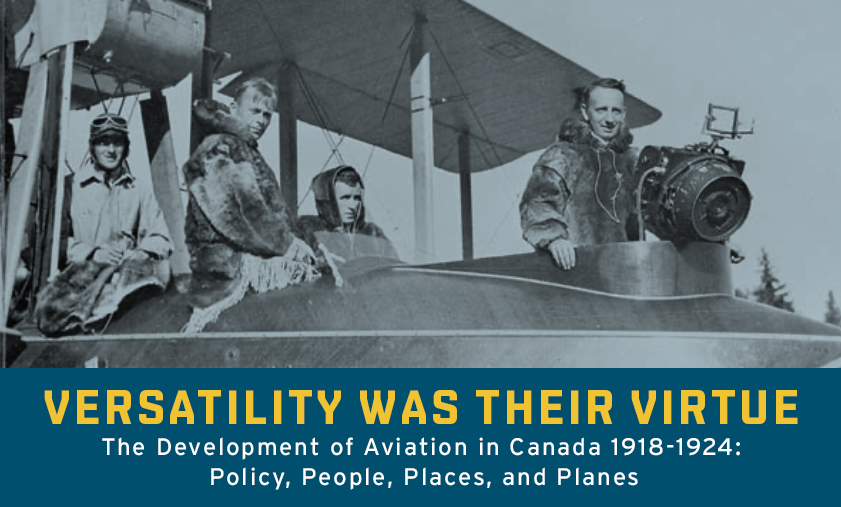
On April 14-15 the Royal Aviation Museum of Western Canada (RAMWC) in Winnipeg will host a special aviation conference on the theme of “Versatility Was Their Virtue,” about the development of civil, commercial and military aviation in Canada from 1918-1924.
Over 20 presentations by invited speakers will contribute to a lively program with topics on three main subjects: People, Planes and Places. A number of the speakers are well-known to CAHS members from their presentations at other conventions and conferences. They include Richard Mayne, Allan Snowie, Diana Trafford, Matthias Joost, Chris Terry, Ruth Groome and Robert Galway.
Hedley Auld, a volunteer with RAMWC and a member of its aviation research group, will be presenting a luncheon address about the establishment of the Air Station at Victoria Beach, the first air station in Manitoba. Research about that air station and work by the research group helped inspire the concept of planning the conference.
“While we were digging into the first trans-Canada flight of 1920, from Dartmouth, Nova Scotia, to Richmond B.C., we encountered a wealth of material of which we had not previously been aware. These were not necessarily new discoveries; they were largely re-discoveries,” says Terry Slobodian, president and CEO of the museum. “It dawned on us that it would be important to review the events that led to the development of Canadian civil, commercial and military aviation in the critical period from 1918-1924.”
The 1918 Airco DH.9A biplane, shown here, flew the final leg, including those by seaplanes, of the first trans-Canada flight in a relay across the country in October 1920. (Photo via internet)
A fine article about the 1920 cross-country flight, organized by the Canadian Air Board to publicize the value and versatility of aviation, was written by Col (Ret.) John Orr and appeared in SKIES magazine, which can be seen when you click here. John is one of the featured speakers for the conference.
Although there is no direct link of the conference to the 100th Anniversary of the RCAF, there is definitely a tie-in with the establishment of the RCAF on April 1, 1924. “We hope that the conference will facilitate research into Canadian aviation from 1918-1924,” says Terry Slobodian. As a follow-up to the conference, proceedings of the event will be published, for which funding has been received. It is expected that they will be available in time for the RCAF Centennial in 2024.
The event will raise the visibility of an era of Canadian aviation history, and highlight the museum and its unique archival collection relating to the development of Canadian aviation. Since opening on May 21, 2022, the Royal Aviation Museum of Western Canada has had over 77,500 visitors by the end of February 2023. Included in that number are a great many students attending the museum on school visits.
Full information about the conference, speakers and sessions can be found on the museum’s web site when you click here.
Full registration cost including parking, all sessions, lunches and end-of-day receptions is only $129.00, with early bird rate by March 31 of $119.00. As well, for anyone unable to attend in person, virtual access cost is $49.00, with early bird price of only $39.00.
The Friday lunch address by Hedley Auld will be about Basil Hobbs (1894-1963), DSO, O.B.E., DSC, a member of Canada’s Aviation Hall of Fame, who was one of the pilots of the 1920 trans-Canada flight. The museum’s mascot, Hobbs, is named in honour of Basil Hobbs, whose grandson, Duncan Hobbs, is president of Charton Hobbs, a supplier of wine and spirts established in 1925 by Basil Hobbs. The company is the sponsor of the end-of-day receptions that will provide opportunity for conference attendees to visit and share their interests in Canadian aviation.
Join us on February 23 for National Aviation Day as we commemorate the past, celebrate the present, and advance the future of aviation in Canada.
11 am – 12 pm: Founders’ talk Two of our founders, Gord Emberley and Keith Olson, will be on-site to share personal stories and speak about the nearly 50-year history of our museum.
11 am – 3 pm: Boeing booth Representatives from Boeing Winnipeg will join us for as part of their outreach for Engineering Week, Feb 20-24, 2023.
Their booth will have information on engineering careers with Boeing, an airplane parts “show-and-tell”, and you can win a prize in their paper plane competition
12 pm – 2 pm: Bellanca restoration feature
1:45 pm: Museum tour with Gerry Suski 2:00 pm: Museum tour with Fred Petrie Join a tour with one of our expert guides and discover 100 years of aviation history.
6 pm – 9 pm: Photography night at the museum — click here to learn more
We recently made a visit to our new off-site restoration facility to see what our loyal volunteers are working on. Read on to find out what’s happening…
Final touches on the Bellanca Aircruiser restoration
Bellanca Aircruiser CF-AWR, 1935 and 2023
Spot the difference! What’s missing from the Bellanca in the present-day photo on the right? If you guessed engine cowling and wheel pants, you’re right!
Before aircraft had retractable landing gear, wheel pants were used to reduce drag, protect the wheels and struts, and improve speed. The aircraft cowling also reduces drag and cools the engine.
The team is working hard to fabricate these two components for our Bellanca Aircruiser so it can be fully restored to match its original condition.
Pedal planes
Shawn Romas is one of our restoration team volunteers and he’s a man of many talents. Aside from helping to fix up aircraft for the museum, he’s been busily working on a fleet of kids’ pedal planes.
These fun, ride-on toys are built to resemble our de Havilland Tiger Moth, the first aircraft to greet you when you enter the Royal Aviation Museum.
Each has been given call letters that memorialize a past restoration volunteer, a squadron number, and a serial number. Shawn even made gauges for each plane.
So, what’s the plan for these pedal planes?
As soon as the weather allows it, Estelle Regnier—the same artist who painted the beautiful murals under our Musketeer and in our Galaxy Exploration Zone—will paint an outdoor track in Aviation Plaza. Once the pedal planes are roadworthy, they’ll be made available to our young visitors!
Wind T (aka “Mr. T”)
Dubbed “Mr. T” by our restoration team, our landing T recently made the trek to our new restoration facility nearby.
A landing tee is one type of visual wind indicator. They’re erected at certain airports to indicate wind direction. When facing into the wind, the wind tee swings with the wind, making the letter “T” readable.
Visual wind indicators can be used to identify wind direction when Air Traffic Control reports are unavailable or if the information on a Common Traffic Advisory Frequency (CTAF) may be unreliable.[1]
After sitting in storage for many years, Mr. T needs a lot of TLC. He’s got some dents and dings, some rust, and a few missing parts.
This is one of the projects our restoration team will be working on over the winter. Hopefully, you’ll see Mr. T all fixed up and next to the Voodoo in the coming months.
Fox Moth/Oster/Fairchild F-24
de Havilland Fox Moth, Taylorcraft Auster, Fairchild F-24
Some of our aircraft are still in storage throughout the province, but there are three in our restoration facility that are almost ready for display: the de Havilland Fox Moth, the Taylorcraft Auster, and the Fairchild F-24.
Will one or all of these make an appearance in our museum soon? Stay tuned to find out!
Arriving October 22 at 11 am and bringing our on-site aircraft total to 25, we’re excited to welcome the eye-catching Douglas A-26B Invader.
Purchased by Ross Robinson in 2007, this aircraft, C-GWLT, has a storied history dating back to 1944.
Manufactured towards the end of WWII, the Invader—sometimes called the “Badass Invader”—was used extensively during the Korean and Vietnam Wars and the Bay of Pigs Invasion.
After their retirement in 1969, many of the aircraft ended up in civilian hands. C-GWLT was converted to a water bomber and used to combat forest fires.
Robinson, a vintage military aircraft enthusiast, acquired the plane specifically for use at airshows and to complement his 1952 Harvard Mark IV. Its previous owners had painted it in shades of blue, an impractical colour scheme, notes Robinson. “Why would you paint an aircraft the same colour as the sky?” The aircraft’s current livery is eclectic, and there’s no doubt it garners attention at airshows.
Ross Robinson with his Invader
Though it never flew with the RCAF, the Invader displays the air force logo and tail number 098, a nod to the “Trail of 98” in Yukon Territory. Back in the 1970s, this aircraft operated as Invader 7 out of Air Spray’s base in Whitehorse, YT and pilots who flew her requested a name befitting her time there. The reference to the Trail of 98 was chosen for its significance during the Klondike gold rush of 1898.
The aircraft also bears the Manitoba flag and markers to commemorate the F-86 Sabre of the 439 Fighter Squadron.
For the past 15 years, C-GWLT has been a highlight at airshows across Canada. October 22 will mark its final “mission” as it rolls into Aviation Plaza to join our collection. Owner Ross Robinson and Chief Pilot Alan Nimmo will be on-site to speak about the aircraft and its history beginning at 11 am.
Ross Robinson’s Harvard Mark IV and Douglas A-26B Invader en route to an airshow
About the Royal Aviation Museum of Western Canada The Royal Aviation Museum of Western Canada was established in 1974 by a small group of visionaries committed to preserving Canada’s distinct aviation heritage. Today, with nearly 100 historic aircraft and more than 70,000 artefacts and archival records (including photographs), the museum remains one of Canada’s largest and most complete aviation heritage collections. Through remarkable storytelling and engaging exhibits that enable visitors and students to discover the science behind flight, this collection is sure to inspire future generations of aviators and inventors. RAMWC is located on the campus of the Winnipeg Richardson International Airport and will be a premier attraction for the city of Winnipeg. Located on Treaty No. 1 Territory, the traditional lands of the Anishinaabeg, Cree, Oji-Cree, Dakota, Lakota, and Dene Peoples, and the homeland of the Métis Nation, RAMWC is committed to Truth and Reconciliation, and to creating a safe space for this to occur.
The Lockheed L‐10A Electra arrives to permanent home for the public to enjoy
MONTREAL, Sept. 7, 2022 /CNW Telbec/ – In celebration of its 85th anniversary, Air Canada today donated its historic aircraft, an original Lockheed L-10A Electra airplane to Winnipeg’s Royal Aviation Museum of Western Canada. The iconic aircraft, the first fleet type flown by the carrier, made its final journey as it taxied from the Air Canada hangar at Winnipeg International Airport to the Museum at a handover ceremony. The airplane will go on permanent public display as an iconic piece of aviation history.
The aircraft, with registration CF-TCC, was one of three purchased by Air Canada’s forerunner, Trans-Canada Air Lines (TCA), in 1937. It was until recently one of only two Lockheed L10-A Electra aircraft still flying in the world.
Named after a bright star in the Pleiades star cluster, the 10A Electra was the pride of the Lockheed Aircraft Corporation. In the 1930s, this twin-engine, all-metal monoplane was the exciting new face of commercial aviation.
“There is no more fitting preservation and commemoration for one of our original aircraft than to have TCC be on permanent display in Winnipeg, which was one of TCA’s original hubs when the airline began operations in 1937 thanks to its central location in our country. Air Canada has a long and rich history connecting Canadians from coast to coast which continues to this day, and it all started with the Lockheed L-10A 85 years ago. As we celebrate our 85th anniversary, we mark this milestone by ensuring that such an important part of Canadian aviation history will be available for Canadians and aviation enthusiasts to enjoy for many years to come,” said Captain Murray Strom, Senior Vice President – Flight Operations at Air Canada.
“We’re very pleased that CF-TCC has landed at the Royal Aviation Museum and is now part of our permanent collection. This aircraft has ties to Winnipeg dating back to 1937 and to our museum in particular,” notes Museum President & CEO Terry Slobodian. “Our museum was previously located in the original TCA hangar here in Winnipeg. The Lockheed Electra is a perfect picture of the early days of commercial air travel in Canada. We are grateful to Air Canada for their longstanding support of our museum and for entrusting us with this spectacular piece of aviation history.”
The History of CF-TCC
CF-TCC was one of three L-10A aircraft purchased by Trans-Canada Air Lines. The L-10A aircraft type operated TCA’s inaugural flight on September 1, 1937, a 50-minute trip from Vancouver to Seattle carrying mail and two passengers.
TCA had acquired the route plus two Lockheed L‐10A aircraft from Canadian Airways. In that same month, TCA bought three additional Lockheed L‐10A aircraft, brand new, from the Lockheed factory for $73,000 each. These aircraft were dubbed the “Three Sisters” and carried the registrations CF‐TCA, CF‐TCB, and CF‐TCC. The first aircraft, CF‐TCA is now at the Canadian Aviation and Space Museum in Ottawa. CF-TCC last flew in 2018, and was one of two remaining Lockheed L‐10A Electra aircraft still flying in the world.
After being operated by TCA from 1937 to 1939, CF‐TCC was sold to the Department of Transport – Canada. During the next 40 years, the aircraft was sold several times to various private corporations and individuals.
In 1962, CF-TCC was leased by TCA and six of the original TCA pilots operated a commemorative flight across Canada on the occasion of TCAs 25th Anniversary.
In 1975, a retired Air Canada employee recognized the faded old registration marks on the aircraft while attending an air show in Texas. Air Canada kept track of the aircraft until 1983, at which point the airline purchased back the aircraft, restored it, and flew it during the Air Canada 50th Anniversary celebrations in 1986. At the end of the Fifty stop Canadian tour, CF‐TCC was featured in the Air Canada pavilion during Expo 86 in Vancouver.
Since 1986, the aircraft has been maintained in flying condition. Volunteers and support from the broader aviation community, including from Air Canada Maintenance and Flight Operations, over the years have dedicated thousands of hours of personal time and other contributions into keeping CF‐TCC flying for generations to enjoy. When not flying, the aircraft has been based in the Western Canada Aviation Museum in Winnipeg, Manitoba, or stored in Air Canada’s Winnipeg hangar.
On September 21, 2007, it recreated TCA’s first flight from Vancouver to Seattle, marking Air Canada’s 70th Anniversary.
In 2012, as part of Air Canada’s 75th Anniversary Celebrations, CF‐TCC made several air show and public appearances, showcasing Air Canada’s heritage and the history of commercial aviation in Canada.
In 2017 to mark the carrier’s 80th anniversary, Air Canada’s Lockheed 10A took to the skies for a cross country tour, beginning with a public appearance at the Royal Aviation Museum in Winnipeg. Along the way, the aircraft made stops in Vancouver, Calgary, Edmonton, Saskatoon, Regina, Winnipeg, Thunder Bay, Sudbury, Toronto, Ottawa, Halifax, Quebec City.
In 2022, on occasion of Air Canada’s 85th anniversary, the airline’s Lockheed 10A made its final journey to the Royal Aviation Museum of Western Canada in Winnipeg. CF-TCC was taxied to the Museum from Air Canada’s Hangar by the aircraft’s long-time advocates and volunteers, Retired Captain Robert Giguere, Retired Captain Gerry Norberg, Retired Aircraft Maintenance Engineer George Huntington, and Air Canada Aircraft Maintenance Engineer Mike Clarkson.
By the Numbers:
1937 Lockheed L‐10A Crew: 2 Pilots, 1 Flight Attendant (known as a Stewardess in 1937.) Capacity: 10 passengers Length: 38 ft 7 in Wingspan: 55 ft 0 in Height: 10 ft 1 in Empty weight: 6,454 lbs Max Weight: 10,500 lbs Powerplant: 2 × Pratt & Whitney R‐985Wasp Junior SB, 450 HP ea. Cruise speed: 140 knots, 190 mph Range: 713 miles / 1,147 kilometres Normal Cruising Altitude: 6,000 – 10,000 ft
Boeing 777-300ER (Air Canada’s largest aircraft) Crew: 2 or 4 Pilots, up to 12 flight attendants Capacity: Up to 450 passengers Length: 242 ft, 9 in Wingspan: 213 ft, 3 in Height: 62 ft, 4 in Empty weight: 353,600 lbs Max Weight: 775,000 lbs Powerplant: 2 GE90-115B engines Cruise speed: 484 knots, 557 mph Range: 9,068 miles / 14,594 kilometres Normal Cruising Altitude: 35,000 ft
About Air Canada
Air Canada is Canada’s largest airline, the country’s flag carrier and a founding member of Star Alliance, the world’s most comprehensive air transportation network celebrating its 25thanniversary in 2022. Air Canada provides scheduled passenger service directly to 51 airports in Canada, 51 in the United States and 86 internationally. It is the only international network carrier in North America to receive a Four-Star ranking from Skytrax, which in 2021 gave Air Canada awards for the Best Airline Staff in North America, Best Airline Staff in Canada, Best Business Class Lounge in North America, and an excellence award for managing COVID-19. Through its leading travel loyalty Aeroplan program, Air Canada offers the ability to earn or redeem points on the world’s largest airline partner network of 45 airlines, plus through an extensive range of merchandise, hotel and car rental rewards. Its freight division, Air Canada Cargo, provides air freight lift and connectivity to hundreds of destinations across six continents using Air Canada’s passenger flights and cargo-only flights with its fleet of Boeing 767-300 freighters. Air Canada has committed to a net zero emissions goal from all global operations by 2050.
Winnipeg, 6 September 2022 – The Royal Aviation Museum of Western Canada (RAMWC) is excited to add the Lockheed L-10A Electra, CF-TCC, to its permanent collection. The aircraft is being donated by Air Canada in celebration of its 85th anniversary and will arrive September 7, 2022 during a special event. One of the first aircraft in the Air Canada (previously Trans-Canada Air Lines or TCA) fleet, the Lockheed L-10A Electra will be a stunning addition to the museum’s collection. The Lockheed Electra is perhaps most well-known as the aircraft flown by Amelia Earhart during her attempted around-the-world flight in 1937.
Speakers include Terry Slobodian, President & CEO – RAMWC; Captain Murray Strom, Senior VP of Flight Operations – Air Canada; Doyle Piwniuk, Minister of Transportation & Infrastructure. Former AC Captains Gerry Norberg and Robert Giguere will be taxiing the plane from Air Canada’s hangar to RAMWC and will also be speaking.
WHEN Wednesday, September 7, 2022 Doors open at 9:30, aircraft arrives at 10:00 am
WHERE Royal Aviation Museum of Western Canada, 2088 Wellington Avenue
About the Royal Aviation Museum of Western Canada The Royal Aviation Museum of Western Canada was established in 1974 by a small group of visionaries committed to preserving Canada’s distinct aviation heritage. Today, with nearly 100 historic aircraft and more than 70,000 artefacts and archival records (including photographs), the museum remains one of Canada’s largest and most complete aviation heritage collections. Through remarkable storytelling and engaging exhibits that enable visitors and students to discover the science behind flight, this collection is sure to inspire future generations of aviators and inventors. RAMWC is located on the campus of the Winnipeg Richardson International Airport and will be a premier attraction for the city of Winnipeg. Located on Treaty No. 1 Territory, the traditional lands of the Anishinaabeg, Cree, Oji-Cree, Dakota, Lakota, and Dene Peoples, and the homeland of the Métis Nation, RAMWC is committed to Truth and Reconciliation, and to creating a safe space for this to occur.
(WINNIPEG, MB – September 2, 2022) – The Royal Aviation Museum of Western Canada is excited to add the Lockheed L-10A Electra, CF-TCC, to its permanent collection. The aircraft is being donated by Air Canada in celebration of its 85th anniversary and will arrive on September 7, 2022, during a special event.
Photo courtesy of Air Canada/RAMWC
One of the first aircraft in the Air Canada (previously Trans-Canada Air Lines or TCA) fleet, the Lockheed L-10A Electra will be a stunning addition to the museum’s collection.
Lockheed L10A Electra CF-TCC in flight, photo courtesy of Air Canada/RAMWC
“We’re very pleased that CF-TCC has landed at the Royal Aviation Museum and is now part of our permanent collection. This aircraft has ties to Winnipeg dating back to 1937 and to our museum in particular,” notes Museum President & CEO Terry Slobodian. “Our museum was previously located in the original TCA hangar here in Winnipeg. The Lockheed Electra is a perfect picture of the early days of commercial air travel in Canada. We are grateful to Air Canada for their longstanding support of our museum and for entrusting us with this spectacular piece of aviation history.”
Retired Captain Robert Giguere in co-pilot’s seat of Lockheed L-10A Electra, CF-TCC. RAMWC photo.
The Lockheed Electra is perhaps most well-known as the aircraft flown by Amelia Earhart during her attempted around-the-world flight in 1937.
To celebrate the arrival of this iconic plane, the museum is hosting a special event on September 7.
About the Royal Aviation Museum of Western Canada
The Royal Aviation Museum of Western Canada was established in 1974 by a small group of visionaries committed to preserving Canada’s distinct aviation heritage. Today, with nearly 100 historic aircraft and more than 70,000 artefacts and archival records (including photographs), the museum remains one of Canada’s largest and most complete aviation heritage collections. Through remarkable storytelling and engaging exhibits that enable visitors and students to discover the science behind flight, this collection is sure to inspire future generations of aviators and inventors. RAMWC is located on the campus of the Winnipeg Richardson International Airport and will be a premier attraction for the city of Winnipeg. Located on Treaty No. 1 Territory, the traditional lands of the Anishinaabeg, Cree, Oji-Cree, Dakota, Lakota, and Dene Peoples, and the homeland of the Métis Nation, RAMWC is committed to Truth and Reconciliation, and to creating a safe space for this to occur.