NAV CANADA has been closely monitoring air traffic forecasts and is taking the necessary steps to ensure it has appropriate staffing to support the aviation industry recovery. Today, NAV CANADA has cancelled surplus notices to 41 air traffic controllers in area control centres in Gander, Moncton, Montreal and Edmonton. These air traffic controllers will remain on the job to provide vital air navigation services as the aviation industry begins its recovery.
“We are proactively taking this action to support our customers as they shift their focus to recovery. NAV CANADA remains ready and able to ensure the continued safety of Canada’s airspace as demand for air navigation services grows,” said Ray Bohn, President and CEO.
From the onset of the pandemic, NAV CANADA has been working to support safe operations and ensure the long-term sustainability of the Company. NAV CANADA’s workforce planning processes include multiple sources of information, including air traffic forecasts, which are designed to ensure that operations have the required resources to safely manage traffic throughout the pandemic, industry recovery and beyond.
“NAV CANADA will play a pivotal role in the sector’s recovery and remains committed to protecting the safety of the travelling public now and in the future,” added Bohn.
About NAV CANADA
NAV CANADA is a private, not-for-profit company, established in 1996, providing air traffic control, airport advisory services, weather briefings and aeronautical information services for more than 18 million square kilometres of Canadian domestic and international airspace. The Company is internationally recognized for its safety record, and technology innovation. Air traffic management systems developed by NAV CANADA are used by air navigation service providers in countries worldwide.
5-year timeline for recovery at Gander and St. John’s airports
Garrett Barry · CBC News · May 12, 2021
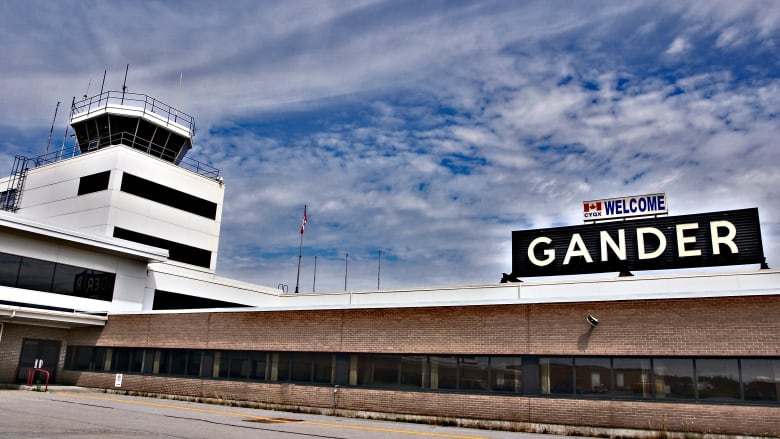
Gander’s airport is a ghost town these days. Passenger traffic plummeted in 2020 to just 51,000 passengers. (Garrett Barry/CBC)
A pair of reports issued by airports in Newfoundland and Labrador suggest the toughest years are still to come for the industry.
Both the Gander and the St. John’s airports released their annual reports this month, and both suggest revenues won’t fully rebound from the COVID-19 pandemic until at least 2025.
In fact, both airports expect to have larger operating losses in 2021 then they did in 2020, according to projections included in their reports.
“The issue the airport has is not what’s happened in 2020; it’s what’s going to happen between 2021 and 2025, which is when we project … passenger traffic to recover to 2019 levels,” said Reg Wright, CEO of the Gander International Airport Authority.
Even then, the Gander airport is projecting revenue to reach only $6.5 million — significantly less than the $10 million once anticipated for 2020.
The revenue losses mean the suspension of some construction projects and layoffs to some full-time and seasonal workers. The St. John’s Airport Authority reported it laid off 17 per cent of its staff to save $4 million.
Reg Wright, CEO of the Gander Airport Authority, says he doesn’t expect passenger traffic to recover until 2025. (CBC)
Wright said recovery will be slow due to the potential emergence of new coronavirus variants and outbreaks, and the uneven vaccination pace around the world.
But he fears the traffic recovery will take longer in Gander, which may be a victim of a “geographically uneven recovery.” He said airlines, which are also hurting, will refocus their operations in bigger and more profitable centres.
“When they talk about small markets and getting back to them, they’re talking about places like Winnipeg and Halifax. So you can imagine where Gander sits in terms of recovery,” he said.
Feeling the pain
Wright said the withdrawal of several air routes from his airport, including the only routes leaving the province, has led to pain in the surrounding region — and not just for leisure travellers.
He compared it to losing high-speed internet access.
“All these problems suddenly arose; couldn’t get locums in from Halifax, so it affected the delivery of health care,” he said. “Essential workers were adding 7½- to eight-hour return journeys onto their trip west. Core samples — mining sector in central [Newfoundland] is on bust — couldn’t get those out.”
That’s partly why he says the provincial government will need to help prop up the air travel sector.
“My suggestion to them is they are going to have to take an active role in restoring air linkages. And in some cases, they might have to match airport subsidies or incentives for service that is critical to the economic well-being of the province.”
Plummeting pace
The Gander airport saw about 51,000 passengers through their doors this year, the lowest number on record.
In St. John’s, passenger traffic fell by 75 per cent in 2020, and airport CEO Peter Avery wrote in his report that it remains at a 50-year low.
“This is a devastating reality for an island reliant on air travel,” he wrote.
Both airports have made significant spending cuts a a result of the losses.
In St. John’s, airport management decided to indefinitely suspend the west terminal expansion project, which was set to add gates and baggage carousels.
The Gander Airport, for the first time in its history, shut down one of its two runways over the winter, to save money on maintenance.
The National Trust of Canada once called Gander Airport’s international departures lounge the most important modernist room in Canada. (Garrett Barry/CBC)
However, the airport authority has decided to continue with their international lounge renovations. Wright said it’s being in done in the hope that the airport will be “in a position of growth at some point.”
OTTAWA, ON, May 11, 2021 /CNW/ – The global COVID-19 pandemic has had an unprecedented impact on the air sector in Canada. Airports have been significantly affected, experiencing major decreases in traffic over the past 15 months. Despite these consequences, airports have played a crucial role since the start of the pandemic by continuing to provide essential air services, including traveling to medical appointments, air ambulance services, community resupply, getting goods to market, search and rescue operations, and forest fire response.
Today, the Minister of Transport, the Honourable Omar Alghabra, launched two new contribution funding programs to help Canada’s airports recover from the effects of the COVID-19 pandemic:
The Airport Critical Infrastructure Program (ACIP) is a new program providing close to $490 million to financially assist Canada’s larger airports with investments in critical infrastructure-related to safety, security or connectivity;
The Airport Relief Fund (ARF) is a new program providing almost $65 million in financial relief to targeted Canadian airports to help maintain operations.
In addition to launching these two new funding programs, the Minister announced that Transport Canada’s Airports Capital Assistance Program (ACAP) is receiving a funding top-up of $186 million over two years. The ACAP is an existing contribution funding program which provides financial assistance to Canada’s local and regional airports for safety-related infrastructure projects and equipment purchases.
Quote
“Canada’s airports are major contributors to our country’s economy, and play a key role in sustaining the social and economic well-being of our communities, and our local airport workers. These programs will help ensure that, as Canada works towards recovery and travel restart post pandemic, our airports remain viable and continue to provide Canadians with safe, reliable and efficient travel options, while creating and maintaining good paying jobs in the airport sector.”
The Honourable Omar Alghabra Minister of Transport
Quick Facts
The Airport Critical Infrastructure Program (ACIP), the Airport Relief Fund (ARF), and the Airports Capital Assistance Program (ACAP) funding top-up and program expansion were originally announced in the Fall Economic Statement in November 2020.
The Airport Critical Infrastructure Program (ACIP) will distribute $489.6 million in funding over five years to airports for eligible projects such as runway repairs/rehabilitation, airfield lighting enhancements, investments in terminal buildings, and transit stations to ensure connectivity to mass transit systems.
On April 15, 2021, the Government of Canada announced a contribution of up to $100 million towards the $600-million project to construct a new Réseau express métropolitain (REM) light rail underground station at the Montreal-Trudeau International Airport. Federal funding for this project comes from the Airport Critical Infrastructure Program (ACIP).
The Airport Relief Fund will provide $64.8 million in funding to airports whose 2019 revenues were less than $250 million. The amount of funding to each targeted eligible recipient will be calculated using a tiered formula-based approach, based on 2019 revenues.
In addition to the one-time funding top-up of $186 million, eligibility for the Airports Capital Assistance Program (ACAP) has been temporarily expanded to allow National Airport System airports with less than one million annual passengers in 2019 (Gander, Charlottetown, Saint John, Fredericton, Moncton, Thunder Bay, London, and Prince George) to apply for funding under the Program in 2021-2022 and 2022-2023.
For 2021-2022, funding has been awarded to 63 airports for 86 ACAP projects, including runway and taxiway repairs/rehabilitation, lighting enhancements, purchasing snow clearing equipment and firefighting vehicles and installing wildlife fencing.
See you in Comox! Be sure to tag us if you see us on the road. 🚚 The personnel going to Comox will be closely following every provincial and federal COVID measure. pic.twitter.com/BrvuRI6Ice
June 5 ‑ 6 To be announced 9 North Bay, Ontario 12 ‑ 13 To be announced 19 ‑ 20 Niagara Falls, New York, USA 22 Hanover, Ontario 24 To be announced 26 Bagotville, Quebec
July 1 Ottawa, Ontario 5 Thompson, Manitoba 17 Boundary Bay, British Columbia 18 White Rock, British Columbia 21 Terrace, British Columbia 24 ‑ 25 Springbank, Alberta 31‑ 1 To be announced
August 6 ‑ 8 Abbotsford, British Columbia 21 Gander, Newfoundland 22 Conception Bay South, Newfoundland 25 Lunenburg, Nova Scotia 29 ‑ 30 Debert, Nova Scotia
Tour operator to offer weekly flights from Halifax, Moncton, Saint John, Fredericton, St. John’s, Deer Lake and Gander
TORONTO, April 27, 2021 (GLOBE NEWSWIRE) — Sunwing is making it easier for residents of Atlantic Canada to head back to the tropics this winter, with convenient weekly flights from regional gateways across Nova Scotia, New Brunswick and Newfoundland. Residents of Halifax, Moncton, Saint John, Fredericton, St. John’s, Deer Lake and Gander can make their much-anticipated return to paradise with vacation packages to some of the most popular destinations across the Caribbean and Mexico. Flights will begin in January 2022 and run weekly until May 2022.
“We’re thrilled to be returning to Atlantic Canada for another winter season,” commented Andrew Dawson, President of Tour Operations for Sunwing Travel Group. “After a difficult year, we’re sure that Canadians will be eager to return to paradise and enjoy some much-needed rest and relaxation. We’re excited to be able to help them enjoy a frictionless vacation experience with convenient flights from local gateways across the region.”
Residents of Atlantic Canada will be able to choose from a range of vacation packages designed for every travel style and budget. Sun-seekers can Vacation Like a Star™ at the newly-opened Planet Hollywood Beach Resort Cancun and the first-ever Planet Hollywood Adult Scene Cancun, featuring entertainment-themed facilities and authentic Hollywood memorabilia around the resort. Those looking to make the most of their vacation budget can enjoy exclusive RIU®-topia inclusions at Canadian-favourite chain RIU Hotels & Resorts, including the recently renovated Riu Montego Bay. Plus, travellers who book by April 30, 2021 for travel between November 1, 2021 and April 30, 2022 can enjoy flexible booking options with the ability to change their plans with ease and save up to $1,000 per couple during the tour operator’s Freedom 21/22 Sale.
The flight schedule from Halifax, NS will be as follows:
Between Halifax and Cancun, Sundays from January 16, 2022 until May 8, 2022
Between Halifax and Montego Bay, Mondays from January 17, 2022 until May 9, 2022
Between Halifax and Puerto Plata, Tuesdays from January 18, 2022 until May 10, 2022
Between Halifax and Punta Cana, Fridays from January 14, 2022 until May 6, 2022
Between Halifax and Cayo Coco, Wednesdays from January 12, 2022 until May 11, 2022
Between Halifax and Cayo Santa Maria, Thursdays from January 13, 2022 until May 5, 2022
Between Halifax and Holguin, Sundays from January 16, 2022 until May 8, 2022
Between Halifax and Varadero, Thursdays and Saturdays from January 13, 2022 until May 7, 2022
The flight schedule from Moncton, NB will be as follows:
Between Moncton and Cancun, Thursdays from February 10, 2022 until May 5, 2022
Between Moncton and Montego Bay, Sundays from February 13, 2022 until May 8, 2022
Between Moncton and Puerto Plata, Fridays from February 11, 2022 until May 6, 2022
Between Moncton and Punta Cana, Saturdays from February 12, 2022 until May 7, 2022
Between Moncton and Varadero, Fridays from February 11, 2022 until May 6, 2022
The flight schedule from Saint John, NB will be as follows:
Between Saint John and Varadero, Saturdays from February 5, 2022 until May 7, 2022
The flight schedule from Fredericton, NB will be as follows:
Between Fredericton and Cancun, Mondays from February 14, 2022 until May 9, 2022
Between Fredericton and Punta Cana, Wednesdays from February 9, 2022 until May 4, 2022
Between Fredericton and Cayo Coco, Tuesdays from February 15, 2022 until May 10, 2022
The flight schedule from St. John’s, NL will be as follows:
Between St. John’s and Cayo Coco, Thursdays from March 10, 2022 until May 12, 2022
Between St. John’s and Varadero, Saturdays from March 12, 2022 until May 14, 2022
Between St. John’s and Cancun, Fridays from March 11, 2022 until May 13, 2022
Between St. John’s and Montego Bay, Sundays from March 13, 2022 until May 15, 2022
Between St. John’s and Punta Cana, Mondays from March 14, 2022 until May 9, 2022
The flight schedule from Deer Lake and Gander, NL will be as follows:
Between Deer Lake/Gander and Varadero, Tuesdays from March 15, 2022 until May 10, 2022
Between Deer Lake/Gander and Punta Cana, Wednesdays from March 16, 2022 until May 11, 2022
Vacationers can return to these Canadian-favourite destinations and travel with peace of mind knowing that the highest Canadian standards are in place throughout their entire vacation experience with the Safe with Sunwing commitment, created under the advisement of global healthcare leader Medcan.
About Sunwing
The largest integrated travel company in North America, Sunwing has more flights to the south than any other leisure carrier with convenient direct service from airports across Canada to popular sun destinations across the U.S.A., Caribbean, Mexico and Central America. This scale enables Sunwing to offer customers exclusive deals at top-rated resorts in the most popular vacation destinations as well as cruise packages and seasonal domestic flight service. Sunwing customers benefit from the assistance of the company’s own knowledgeable destination representatives, who greet them upon arrival and support them throughout their vacation journey. The company supports the communities where it operates through the Sunwing Foundation, a charitable initiative focused on the support and development of youth and humanitarian aid.
Gander Mayor Percy Farwell examines some photographs hung on the back wall of the mayor’s office in Gander’s town hall. (Garrett Barry/CBC)
Visitors and residents in Gander get a hit of history at just about every street corner: John Alcock, Arthur Brown, Amelia Earhart and Charles Lindbergh.
Each one was a high flyer in the history of transatlantic flight — and each is commemorated in a street name in the Town of Gander.
With just a few exemptions, every street in Gander is named after a pilot or an aviator: There’s Hawker Crescent and Grieve Crescent, named after George Hawker and Kenneth Grieve and their attempt at a transatlantic flight in 1919.
There’s also Sacchi Avenue, named for Louise Sacchi, a pioneering female pilot who ferried planes across oceans hundreds of times.
Gander’s distinct naming policy means there’s a pilot on just about every street sign. Now, that might change — a little.
Louise Sacchi is one of the pilots who have been memorialized in Gander street names. (Gander Airport Historical Society)
Gander’s town council is debating a move that would slightly loosen its naming policy and allow for a greater mix of community figures to be commemorated, as long as they still have some connection to the aviation industry.
“It’s not something that … there’s a consensus that we want to do,” Mayor Percy Farwell said Thursday. “It’s something that is under consideration, under discussion in council right now.”
The town’s development staff has suggested to council that it vote to expand the eligibility and include first responders, innovators, people who’ve had long and successful careers in aviation and people who’ve performed heroic acts.
Farwell said council is a bit “conflicted.”
“It does have sort of resonance in terms of the tourism and the branding and so on of the community to be able to say that all your streets are named after pilots,” he said.
Harry Hawker and Kenneth Grieve are pictured in Mount Pearl. The men both have their names inscribed onto street signs in the Town of Gander in commemoration of their transatlantic flight attempt in 1919. They left from Mount Pearl in May of that year. (Memorial University Archives and Special Collections)
“Now, having said that, I would suggest that if you looked at a list of names of streets here in Gander, the average person with the average level of knowledge about aviation would probably only recognize maybe 15 or 20 of those names.”
Jack Pinsent, an early Gander resident and a history buff, said the policy made more sense when the town was first being built in the 1950s — when it had fewer streets and when there were fewer pilots to honour.
“I think they are down to the point where they are starting to run out of names, aviators that people know,” he told CBC Thursday. “There are some guys, right now, where I look at the name and I say … I never heard tell of that fella before.
“They started naming streets after astronauts, which I was completely against!”
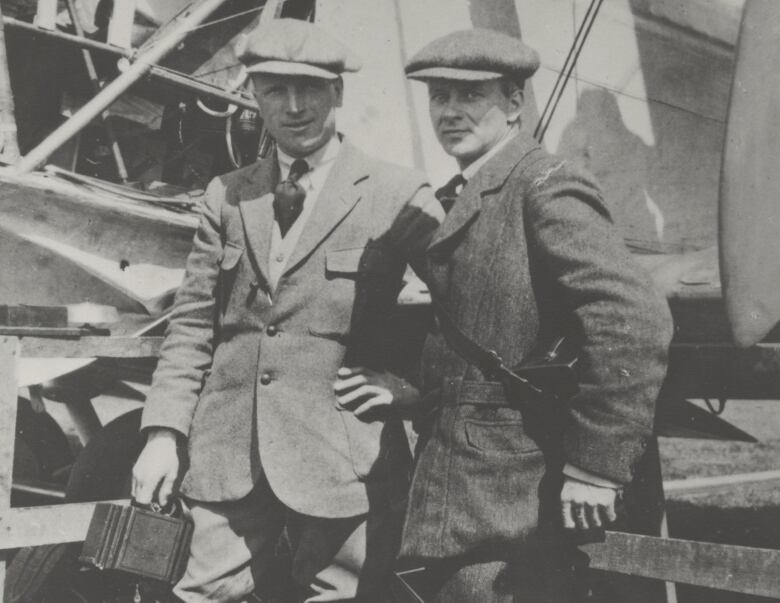
Capt. John Alcock, left, and Lieut. Arthur Whitten Brown stand beside their Vickers plane Vimy at Lester’s Field in June 1919. The pair would fly to Ireland that month, in the first non-stop transatlantic flight. (The Rooms Provincial Archives Division, A 47-15)
Pinsent said town councils have made exceptions in the past — most notably for royalty — and it’s time to formally broaden the criteria to celebrate more of Gander’s own residents.
He says he had four or five in mind already — such as John Murphy, who was a civilian secretary in the Royal Air Force and later left Newfoundland for New York in the 1960s where he became a manager with the Trans World Airlines operations in the state.
No existing streets will be renamed, and Farwell says if town council does bring in a change, it’s unlikely to be a big one. He says there’s a broad agreement that the town staff suggestion — to open the eligibility to those with some other attachment to aviation — is as far as anyone wants to go.
Amelia Earhart is another famous pilot commemorated in a street name in Gander. Earhart was the first female pilot to fly solo across the Atlantic ocean.
“I think there’s fairly good consensus on, you know, connecting the street names all throughout this community to aviation is a fitting tribute and recognition of the heritage of our community, which is unique in the Newfoundland context,” he said.
“Opening it wide open and, you know, I think would betray that and would diminish the the impact that having such a street-naming policy has in a positive way on tourism and so on.”
The government’s financial support to Air Canada is being provided under the Large Employer Emergency Financing Facility (LEEFF). The Canada Enterprise Emergency Funding Corporation (CEEFC) has committed to provide $4 billion in repayable loans and an equity investment in Air Canada of $500 million in newly-issued Class B Voting Shares at a 15 per cent discount to their recent trading price. CEEFC will also receive warrants on Air Canada stock in an amount equal to 10 per cent of the loan commitments (CEEFC’s news release contains detailed information regarding the warrants).
As a condition of its agreement with CEEFC, Air Canada has made a number of commitments as outlined below.
Refunds for Canadians
The agreement with Air Canada ensures that customers who had their flights cancelled, or took action to cancel a flight because of the pandemic, are not financially disadvantaged. Under the terms of the financing agreement, Air Canada has committed to offer refunds to any passenger who wants a refund for certain pandemic-related cancelations by the carrier that CEEFC will finance. Air Canada has committed to providing customers with their refunds as soon as possible – beginning April 30, 2021 at the latest. CEEFC will provide additional loan financing of up to $1.4 billion for Air Canada to provide these refunds. Travel agents may assist in the processing of refunds for tickets the travel agents sold but will not be required to refund their commission to Air Canada.
Protecting Jobs
As a condition of the agreement with CEEFC, Air Canada has committed to maintain jobs at current levels, to respect collective bargaining agreements, and protect workers’ pensions. Air Canada currently has 14,859 active Canadian employees.
As required more generally under LEEFF, Air Canada has also agreed to restrictions on dividends, buying back shares, and executive compensation. The company will also provide climate-related financial disclosures, including how its future operations will support environmental sustainability and national climate goals.
Restarting Vital Domestic Air Services
The terms of the financial support will ensure that Canadians and communities retain air connections to the rest of Canada, through the restart of service at airports temporarily suspended by Air Canada. For seven airports where Air Canada had permanently canceled service, the airline will seek interline agreements with other carriers with a view to ensure those Canadians continue to have convenient access to their preferred airports and the flights they need.
Service will resume by no later than June 1, 2021, at the following suspended airports based on public health advice:
Bathurst
Comox
Fredericton
Gander
Goose Bay
Kamloops
North Bay
Penticton
Prince Rupert
Saint John
Sandspit
Sydney
Yellowknife
Supporting Jobs in Canada’s Aerospace Industry
The aerospace industry supported 235,000 Canadian jobs and contributed over $28 billion in gross domestic product to the Canadian economy in 2019.
This financing agreement will allow Air Canada to continue to be a vital customer of the Canadian aerospace industry by completing its planned purchase of aircraft as set out in its business plan, which includes aircraft built in Canada, such as the Airbus A220. Aerospace is one of the most innovative and export-driven industries in Canada. The negative impact of the pandemic on the bottom line of airlines has put the relationship between airlines and the aerospace industry at risk, threatening job security in the sector. Ensuring that Air Canada maintains its status as a key customer of Canada’s aerospace industry is important to ensuring the long term success of the sector and the thousands of jobs it supports.
Cuts are part of Nav Canada’s countrywide restructuring
Garrett Barry · CBC News · Mar 28, 2021
This is Nav Canada’s air traffic control centre in Gander. Air traffic control jobs are coveted in the town of Gander and are highly paid. (Garrett Barry/CBC)
Twenty-seven air traffic controllers in Gander are living in a state of limbo, having been told they are targets for layoffs that won’t come into effect for months.
They’ve all been given “surplus letters,” informing them they will be laid off in September, barring any changes. In the meantime, the union representing the controllers is promising to fight on their behalf.
“We have a lot of concerns about the process the company has taken,” said Ian Thomson, Atlantic regional vice-president of the Canadian Air Traffic Control Association.
He said the union has filed grievances and an unfair labour practice complaint, and is continuing to speak with Nav Canada.
The coming cuts are part of a restructuring effort launched by Nav Canada last year, and follow earlier cuts to the company’s paid training program. In September, 15 trainees were cut from the program, including seven who were in their final stages, according to the union.
Rebecca Torraville, an air traffic controller in Gander, made this digital drawing representing herself and other air traffic controllers who have been sent layoff notices. There are 27 workers in danger of being laid off, according to their union. (Submitted by Rebecca Torraville)
In a statement, Nav Canada said the cuts are necessary “given the current pressures facing the company.”
“Nav Canada must act promptly to safely streamline operations to ensure that the services supplied align with market demands,” wrote Brian Boudreau, a spokesperson for the company, in the statement.
Ian Thomson, Atlantic regional vice-president of the Canadian Air Traffic Control Association, says the union has filed grievances and an unfair labour practice complaint. (Submitted by Ian Thomson)
Despite the fact that the controllers continue to work, Thomson said the surplus letters have had a devastating impact.
“It’s tough on everybody’s self-worth,” he said. “You put all this effort into training … and for a lot of people, their parents were air traffic controllers, and it’s been a dream of theirs their whole lives.
“In an industry where historically nobody would ever think of a layoff.”
Traffic stalled
The centre in Gander handles transatlantic flights. Prior to the COVID-19 pandemic, it had been a hive of activity.
In 2017 it handled almost 10,000 flights a week, according to statistics from the International Civil Aviation Organization.
But international travel has been particularly hit by the COVID-19 pandemic: down some 85 per cent in January compared with the year before.
Nav Canada’s February traffic data shows that “weighted charging units” — a measure that combines flights, plane size and distance flown — is down 58 per cent across the country compared with February 2020.
An air traffic controller monitors transatlantic routes from the Gander centre in 2019. (CBC)
Thomson says he believes there’s a pent-up demand for travel, and predicts a rapid recovery when COVID-19 restrictions are loosened and more vaccines are administered.
That’s a part of the reason that he’s optimistic that some of the layoff notices will be rescinded, or individuals quickly recalled.
In the meantime, he said, those who have been served with surplus letters are facing a lot of uncertainty.
“The reality is, the training we receive is highly specialized. It’s geared directly toward air traffic control,” he said. “It’s not going to get you into being a doctor or a lawyer, you know. You’re really starting back at Square 1.”
Gander’s mayor, Percy Farwell, says that loss will be felt right across his community. He also hopes that many of the workers and trainees will return to the air traffic control centre when air travel rebounds.
Gander Mayor Percy Farwell says the losses will be felt across the town. (Garrett Barry/CBC)
He estimates many of the trainees that were cut would have stayed in Gander to work, buying houses and cars and spending their salaries in town.
“Young families that would have spent their working lives here, most likely, and everything that entails and adds to our community,” he said. “Having young, active families here. So it’s serious.”
Local bakery says the community has rallied to help it pull through pandemic
CBC Radio · Jan 23, 2021
As the pandemic cancelled the travel plans of millions around the world, Gander International Airport has gone from 12 daily flights to just two. (Gander International Airport Authority)
With the pandemic bringing Newfoundland’s Gander Airport to a standstill, CEO Reg Wright now feels like “a night watchman at a museum.”
“There’s been a sizeable job loss at the airport. The ticket counters are largely empty. The most active people here are generally the cleaners,” he told The Current’s Matt Galloway.
The slowdown is bad news not just for the airport, but “critical” for the town of Gander itself, which was founded off the back of the airport’s prosperity, Wright said.
“The airport came first and the town’s built around it,” he explained.
“Everyone here has some jet fuel running through their veins.”
Travellers at Gander’s airport overlook a 70-foot-long mural by Saskatchewan artist Kenneth Lochhead, in this 1959 photo taken for the National Film Board of Canada. (Gar Lunney/Library and Archives Canada/National Film Board)
Built in the late 1930s, Gander’s airport was a crucial refuelling stop in the decades before better engines allowed direct flights between Europe and North America. The town of Gander followed in the 1950s, and gained international fame when flights were diverted there in the hours after the 9/11 attack — detailed in the hit musical Come From Away. The airport has remained an important connection point to mainland Canada and beyond, with roughly 170,000 passengers passing through it annually in the years before the pandemic. According to its website, the airport contributes 1,260 full-time jobs and $90 million in wages to the region, and has an annual economic impact of $240 million.
With travel heavily restricted in the pandemic, Gander’s 12 daily flights have been reduced to just two. Air Canada has suspended all flights in and out of Gander, which previously accounted for 70 per cent of passenger traffic and 25 per cent of the airport’s total revenue, totalling $2.5 million.
In a statement to CBC News, the airline said the pandemic had led to an 80 per cent drop from the previous year, and the company would “continue to evaluate and adjust its route network” as the pandemic progressed.
The airport is also home to a Nav Canada air traffic control centre, which will be affected by impending national layoffs announced last month. A memo to staff said the company is cutting the highly skilled, highly paid jobs in response to a $518-million drop in revenue, compared to its budget due to COVID-19.
Percy Farwell, mayor of Gander, said that 51 jobs had already been lost at the centre during the pandemic, “which probably represents $6- to $7-million worth of wages in our little community.”
“You can imagine the trickle down from that loss.”
With reduced air connections, Gander Mayor Percy Farwell worries about his community becoming isolated from the rest of Canada. (Garrett Barry/CBC)
He said air travel injects much-needed money into the local economy that is “dependent on movement and congregation of people, and access and connection to the rest of the world.”
“We’re witnessing an unravelling of the national fabric, and our province and our community and region is becoming increasingly isolated.”
Airport standstill hits local businesses
The slowdown and looming job cuts are “scary” for local business, said Steve Bishop, co-owner of the Gander Bread Box, a bakery and cafe a couple of kilometres from the airport.
He’s run the cafe with his wife and co-owner, Marlene Bishop, for more than a decade. But when the pandemic struck last spring, they were forced to lay off their staff and pivot from running a cafe with indoor dining to just selling bread.
Marlene and Steve Bishop run a bakery in Gander, N.L., which has suffered a drop in business as the local airport slowed down during COVID-19.
“You’re watching your bank account dwindle and dwindle and you’re thinking, how are you going to do this?” Marlene said.
The bakery used to supply sandwiches to the airport, as well as host some of its staff for meals. All that business has been lost, Steve said.
Marlene added that anyone facing unemployment is “going to really consider where they’re going to spend their money.”
“They might have to buy a $2 loaf of bread rather than a $3.49 loaf of bread — it will have an effect on us.”
Dennis Barrow drops by with his running club in the mornings, and said it’s not just “part of your routine, it becomes part of your family.”
“Supporting local business is so important and there’s a community, family feel to this business,” he said.
Marlene said they’ve been “very fortunate to have the love of our customers.”
The café has a wall of cups, so regulars can drink their coffee from the same one each day. Clockwise from top left, Gerald Saunders, Craig Dunn, Tony Gabriel, Louise Pumphrey, Tina Purcell and Donna Keith are all regulars at the bakery. (Leigh Anne Power/CBC, Submitted by Marlene Bishop)
Last year, a customer ordered 10 loaves of bread and asked her to ensure they had the cafe’s logo on them as he would be giving them away.
“He hands me a $100 bill and he walks out the door, and this was the kind of thing that was happening,” she said.
She said keeping the business running during the pandemic has been like “raising a child,” but thinks the community would be affected if they had to close.
“There were times that we weren’t entirely sure how we’re going to do this, but you don’t give up on your child and we weren’t going to give up on this place,” she said.
Bailouts needed to keep Canada connected: CEO
Like how the community has helped prop up small businesses, Wright said federal aid is needed to revive airlines, adding that the public should support it the way they’ve adopted physical distancing and mask wearing.
“We’ve all done things for the greater good during this pandemic, and I think people will have a hard time looking at me and saying that, ‘You know, it’s not in the greater good that airlines be viable on the other side of this,’” he said.
“There’s not going to be economic recovery without flow and movement.”
Marlene said they’ve been ‘very fortunate to have the love of our customers.’ (Leigh Anne Power/CBC)
According to the federal government’s fall economic update, Canadian airlines received $1.4 billion to pay up to 75 per cent of employee wages during the pandemic. Air Canada received $492 million to pay its employees over a period ending Sept. 30.
The fiscal update also pledged $1.2 billion for airports, airport infrastructure, and regional airlines. But while other countries have offered billions to help airlines weather COVID-19, the federal government has so far held off on a tailored bailout package, despite pleas from the industry.
Katherine Cuplinskas, a spokesperson for Deputy Prime Minister and Minister of Finance Chrystia Freeland, told The Current in an emailed statement that the federal government is “committed to supporting Canadians airlines,” and is engaged in “ongoing conversations.”
She said further support from taxpayers would depend on reaching agreement over refunding Canadians for cancelled flights, retaining and reinstating regional routes and protecting jobs across the sector.
Reg Wright, CEO of the Gander Airport Authority, said he wants the federal government to offer more support to airlines. (Chris Ensing/CBC)
Wright said he understands customer frustration with airlines that aren’t returning money spent in good faith. But he pointed to the larger task of keeping Canada connected.
“Aviation is the load-bearing wall that holds it all together,” he told Galloway.
“You’re losing services in vital places like Yukon, Cape Breton Island, Saint John, Fredericton, New Brunswick — a capital. It’s unheard of, what’s happening,” he said.
“You’re seeing these dots just wiped off the map.”
Written by Padraig Moran, with files from CBC News. Produced by Ben Jamieson, with additional reporting from Leigh Anne Power.
This story is the first stop in Canada’s Road Ahead, The Current’s series talking to Canadians about how the pandemic has changed their lives, and what comes next.